
티스토리 뷰
완성된 수집 파이프라인은 각 단계를 더 많이 붙이는 구조가 아니라 각 단계의 입출력이 이어지는 구조입니다.

시리즈 마지막 글에서는 조각별 예제를 하나의 실제 흐름으로 이어 붙입니다. 이제 중요한 것은 개별 함수보다도 단계 간 계약이 끊기지 않는지입니다.
이번 예제는 세 포맷을 읽고, 청크를 만들고, 오프라인 임베딩으로 FAISS를 저장한 뒤 다시 로드해서 검색 결과를 확인합니다. 이 정도면 ingestion MVP가 끝까지 한 번 돈 것입니다.
엔드투엔드 수집 파이프라인

마지막 글의 핵심은 각 단계의 세부 구현보다도 앞 단계 출력이 다음 단계 입력으로 자연스럽게 이어지는지 확인하는 데 있습니다.
단계별 검증 체크포인트
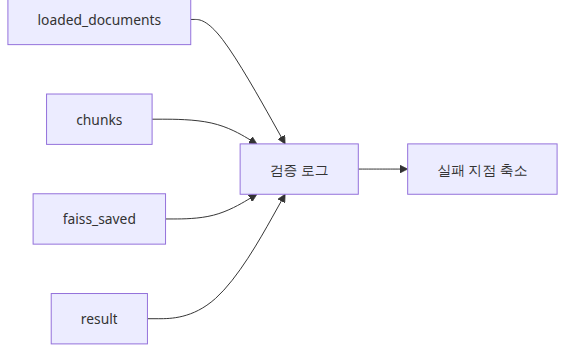
체크포인트를 적게 두더라도 단계 경계마다 숫자와 경로를 하나씩 남기면 원인 추적 속도가 크게 빨라집니다.
실행 예제
# pyright: reportMissingImports=false, reportMissingModuleSource=false
from __future__ import annotations

import hashlib
import shutil
from pathlib import Path

from langchain_community.vectorstores import FAISS
from langchain_core.documents import Document
from langchain_core.embeddings import Embeddings
from langchain_text_splitters import RecursiveCharacterTextSplitter
from pypdf import PdfReader
from reportlab.lib.pagesizes import A4
from reportlab.pdfgen import canvas

BASE_DIR = Path(__file__).resolve().parent
DATA_DIR = BASE_DIR / 'data'
INDEX_DIR = BASE_DIR / 'faiss_store'
DATA_DIR.mkdir(exist_ok=True)

class SimpleHashEmbeddings(Embeddings):
    def __init__(self, size: int = 32):
        self.size = size

    def _embed(self, text: str) -> list[float]:
        vector = [0.0] * self.size
        for token in text.lower().split():
            digest = hashlib.sha256(token.encode('utf-8')).digest()
            for index in range(self.size):
                vector[index] += digest[index] / 255.0
        return vector

    def embed_documents(self, texts: list[str]) -> list[list[float]]:
        return [self._embed(text) for text in texts]

    def embed_query(self, text: str) -> list[float]:
        return self._embed(text)

def create_pdf(path: Path) -> None:
    c = canvas.Canvas(str(path), pagesize=A4)
    c.setFont('Helvetica', 12)
    c.drawString(72, 780, 'PDF source: access policy and retention rules.')
    c.drawString(72, 760, 'Chunk metadata should preserve the original file name and format.')
    c.save()

def seed_files() -> list[Path]:
    pdf_path = DATA_DIR / 'policy.pdf'
    txt_path = DATA_DIR / 'ops.txt'
    md_path = DATA_DIR / 'faq.md'
    create_pdf(pdf_path)
    txt_path.write_text('TXT source: nightly ingestion runs at 02:00 and retries failed files first.
', encoding='utf-8')
    md_path.write_text('# FAQ

MD source: metadata filters reduce the candidate set before answer generation.
', encoding='utf-8')
    return [pdf_path, txt_path, md_path]

def load_file(path: Path) -> list[Document]:
    suffix = path.suffix.lower()
    if suffix == '.pdf':
        reader = PdfReader(str(path))
        text = '
'.join((page.extract_text() or '').strip() for page in reader.pages)
        return [Document(page_content=text, metadata={'source': path.name, 'format': 'pdf'})]
    if suffix == '.txt':
        return [Document(page_content=path.read_text(encoding='utf-8'), metadata={'source': path.name, 'format': 'txt'})]
    if suffix in {'.md', '.markdown'}:
        return [Document(page_content=path.read_text(encoding='utf-8'), metadata={'source': path.name, 'format': 'md'})]
    raise ValueError(f'unsupported format: {suffix}')

def chunk_documents(documents: list[Document]) -> list[Document]:
    splitter = RecursiveCharacterTextSplitter(
        chunk_size=90,
        chunk_overlap=20,
        separators=['

', '
', '. ', ' '],
    )
    chunks = splitter.split_documents(documents)
    for index, chunk in enumerate(chunks):
        chunk.metadata['chunk_id'] = f'chunk-{index:02d}'
    return chunks

def main() -> None:
    files = seed_files()
    loaded = [doc for path in files for doc in load_file(path)]
    chunks = chunk_documents(loaded)
    if INDEX_DIR.exists():
        shutil.rmtree(INDEX_DIR)
    vectorstore = FAISS.from_documents(chunks, SimpleHashEmbeddings())
    vectorstore.save_local(str(INDEX_DIR))
    reloaded = FAISS.load_local(
        str(INDEX_DIR),
        SimpleHashEmbeddings(),
        allow_dangerous_deserialization=True,
    )
    results = reloaded.similarity_search('metadata filters and retention', k=2)

    print(f'loaded_documents: {len(loaded)}')
    print(f'chunks: {len(chunks)}')
    print(f'faiss_saved: {INDEX_DIR}')
    for doc in results:
        preview = doc.page_content.replace('
', ' ')[:90]
        print(f"result={doc.metadata['source']} chunk_id={doc.metadata['chunk_id']} preview={preview}")

if __name__ == '__main__':
    main()
실행 방법
python main.py검증된 실행 결과
loaded_documents: 3
chunks: 4
faiss_saved: /root/Github/document-ingestion-101/ko/06-pipeline-completion/faiss_store
result=policy.pdf chunk_id=chunk-00 preview=PDF source: access policy and retention rules.
result=policy.pdf chunk_id=chunk-01 preview=Chunk metadata should preserve the original file name and format.
이 코드에서 봐야 할 것
모니터링과 장애 복구 흐름

운영용 ingestion은 성공 경로만 그리면 부족하고 어느 단계에서 멈췄는지 되짚을 복구 경로도 함께 있어야 합니다.
load_file()가 포맷 차이를 흡수하고,chunk_documents()가 공통 청크 계약을 만듭니다.SimpleHashEmbeddings덕분에 외부 모델 다운로드 없이도 FAISS 저장·재로딩 흐름을 끝까지 검증할 수 있습니다.- 검증 포인트를
loaded_documents,chunks,faiss_saved,result네 줄로 남겨서 실패 지점을 빠르게 좁힐 수 있습니다.
실무에서 헷갈리는 지점
재시도와 재처리 제어 구조

재시도와 재처리를 같은 버튼으로 취급하면 중복 비용이 커지므로 둘을 다른 제어 경로로 나눠 두는 편이 좋습니다.
- 엔드투엔드 데모라고 해서 LLM 호출까지 꼭 넣을 필요는 없습니다. 먼저 인덱스가 정상 저장·재로딩되는지 확인하는 편이 중요합니다.
- 임베딩 품질과 파이프라인 동작 검증은 다른 문제입니다. 데모 단계에서는 재현성이 더 중요합니다.
- FAISS 저장 후 다시 읽는 절차를 빼면 운영 배포 시 경로, 권한, 직렬화 문제를 놓치기 쉽습니다.
체크리스트
- 세 포맷을 모두 로드했다.
- 청크 수가 기대 범위인지 확인했다.
- FAISS 인덱스를 저장한 뒤 다시 로드했다.
- 재로딩된 인덱스에서 검색 결과를 확인했다.
시리즈 목차
- PDF 파싱과 텍스트 추출
- 청킹 전략 — 문서 유형별 최적화
- 메타데이터 설계와 필터링
- 증분 인덱싱 — 변경된 문서만 업데이트
- 다중 포맷 문서 파이프라인
- 문서 수집 파이프라인 완성 (현재 글)
참고 자료
'AI·LLM' 카테고리의 다른 글
| 다중 포맷 문서 파이프라인 (0) | 2026.05.05 |
|---|---|
| 증분 인덱싱 — 변경된 문서만 업데이트 (0) | 2026.05.05 |
| 메타데이터 설계와 필터링 (0) | 2026.05.05 |
| 청킹 전략 — 문서 유형별 최적화 (0) | 2026.05.05 |
| PDF 파싱과 텍스트 추출 (0) | 2026.05.05 |
공지사항
최근에 올라온 글
최근에 달린 댓글
- Total
- Today
- Yesterday
링크
TAG
- AppService
- LLM
- 공공데이터
- scaling
- CloudArchitecture
- appserviceplan
- ALTAIR
- AZURE
- app service
- DevOps
- streaming
- pandas
- Document Processing
- langchain
- cloudcomputing
- faiss
- Prompt engineering
- Cloud
- openAI
- serverless
- vector search
- rag
- Ai
- Tutorial
- Python
- 데이터시각화
- Kubernetes
- embeddings
- aks
- Azure Functions
| 일 | 월 | 화 | 수 | 목 | 금 | 토 |
|---|---|---|---|---|---|---|
| 1 | 2 | |||||
| 3 | 4 | 5 | 6 | 7 | 8 | 9 |
| 10 | 11 | 12 | 13 | 14 | 15 | 16 |
| 17 | 18 | 19 | 20 | 21 | 22 | 23 |
| 24 | 25 | 26 | 27 | 28 | 29 | 30 |
| 31 |
글 보관함