

티스토리 뷰
LangChain을 처음 보면 용어가 먼저 몰려옵니다. LCEL, Runnable, Chain, Pipe 같은 단어가 연달아 나오는데, 정작 손에 잡히는 것은 "프롬프트 만들고 모델 호출하고 결과 파싱하는 코드"입니다. 그래서 입문 단계에서는 개념을 외우기보다, 반복되는 글루 코드를 LangChain이 어떤 공통 계약으로 정리했는지부터 보는 편이 훨씬 빠릅니다.
이렇게 생각하면 됩니다. LangChain은 새로운 마법을 만든 라이브러리가 아닙니다. 이미 여러분이 애플리케이션에서 하던 일을, 서로 교체 가능한 부품으로 나눈 뒤 같은 실행 인터페이스로 묶어 놓은 도구입니다. 그 인터페이스가 Runnable이고, 그 부품들을 |로 잇는 문법이 LCEL입니다.
이 글에서 다룰 문제
- LCEL은 왜 생겼고, 기존 LLM 코드에서 어떤 글루 코드를 줄여 줄까요?
- LangChain 컴포넌트가 모두 Runnable이라는 말은 정확히 어떤 계약을 뜻할까요?
invoke(),batch(),stream()은 언제 각각 써야 할까요?prompt | llm | parser같은 체인 안에서는 실제로 어떤 데이터가 흐를까요?- 체인을 길게 만들수록 어디서 가장 자주 헷갈릴까요?
LangChain에서는 입력과 출력 모양만 맞으면, 많은 컴포넌트를 서로 바꿔 끼울 수 있습니다.

최소 실행 예제
import os

from langchain_core.output_parsers import StrOutputParser
from langchain_core.prompts import ChatPromptTemplate
from langchain_groq import ChatGroq

prompt = ChatPromptTemplate.from_template("Explain {topic} in one paragraph.")
llm = ChatGroq(model="llama-3.1-8b-instant", api_key=os.environ["GROQ_API_KEY"])
chain = prompt | llm | StrOutputParser()

print(chain.invoke({"topic": "LCEL"}))
Output
LCEL stands for Low-Cost Carrier Equity-like or Low-Cost Carrier Equity Layer. It is a type of investment product that offers exposure to the low-cost airline sector, often through a combination of stock or debt investments in low-cost carriers. LCELs typically provide a more conservative and stable return profile compared to traditional airline stocks by offering a lower-risk, debt-like investment option with a higher yield. They can be structured as exchange-traded notes (ETNs), closed-end funds, or other types of investment vehicles, and may offer a fixed or floating rate of return, often tied to the performance of a specific low-cost airline or a basket of airlines.이 짧은 예제만 봐도 LangChain의 핵심 구조가 드러납니다. 프롬프트는 입력 dict를 메시지로 바꾸고, 모델은 그 메시지를 받아 응답을 만들고, 파서는 응답 객체를 애플리케이션이 다루기 쉬운 문자열로 바꿉니다. 세 단계가 모두 Runnable 계약을 따르기 때문에 | 하나로 연결됩니다.
이 코드에서 먼저 볼 점
ChatPromptTemplate은 dict를 받아 채워진 채팅 메시지로 바꿉니다.ChatGroq는 메시지를 받아AIMessage를 반환합니다.StrOutputParser는 최종 결과를 문자열로 정규화합니다.- 파이프가 동작하는 이유는 세 객체가 모두 Runnable을 구현하기 때문입니다.
엔지니어가 여기서 자주 헷갈리는 지점
- LCEL은 모델 기능이 아니라 컴포넌트 조합 문법입니다.
invoke()와stream()은 체인 정의를 바꾸지 않고 실행 방식만 바꿉니다.RunnableLambda는 가벼운 변환 단계로는 좋지만, 애플리케이션 구조 자체를 대체하는 도구는 아닙니다.
체크리스트
-
prompt | llm | parser각 단계의 입력과 출력을 설명할 수 있다 -
invoke(),batch(),stream()을 언제 선택할지 안다 - Groq를 이용한 최소 LCEL 체인을 끝까지 실행해 봤다
LangChain 101 (1/6)
Example code: github.com/yeongseon-books/langchain-101
이 글에서 다룰 문제
- LCEL은 왜 컴포넌트를
|연산자로 연결할까요? - 공통 Runnable 인터페이스는 어떤 메서드들로 이루어질까요?
- 프롬프트, 모델, 파서의 출력은 체인 안에서 어떻게 맞물릴까요?
invoke()대신batch()를 고르는 기준은 무엇일까요?
LCEL은 프롬프트, 모델, 파서를 모두 같은 Runnable 인터페이스로 맞춘 뒤, 하나의 실행 가능한 데이터 흐름으로 묶는 LangChain의 방식입니다.
전체 흐름 한눈에 보기

LangChain 입문에서 가장 중요한 것은 용어 정의보다 멘탈 모델입니다. LLM 앱은 결국 "입력을 가공해 프롬프트를 만들고, 모델을 호출하고, 결과를 후처리하는 파이프라인" 이라고 보면 됩니다. LangChain은 이 반복 구조를 라이브러리 레벨에서 재사용 가능하게 만든 것입니다.
이 시리즈는 LangChain을 애플리케이션 패턴이 아니라 API 조립 도구로 이해하는 데 초점을 둡니다. 챗봇, RAG, 에이전트 같은 상위 수준 패턴은 별도 시리즈에서 다루고, 여기서는 LangChain 컴포넌트가 어떻게 맞물리는지부터 차근차근 쌓겠습니다.
이 글에서 다룰 범위는 다음과 같습니다.
- LangChain이 줄이려는 반복 글루 코드
- Runnable 인터페이스의 세 핵심 메서드:
invoke(),batch(),stream() - LCEL 파이프 연산자
|로 체인을 조립하는 방식 - 가장 단순한 체인을 직접 실행해 보는 흐름
- 이 구조를 익혀 두면 이후 글이 왜 쉬워지는지
LangChain이 해결하려는 문제

LLM 애플리케이션 코드는 금방 비슷한 패턴으로 굳어집니다. 프롬프트 문자열을 만들고, 모델 API를 호출하고, 응답에서 텍스트를 꺼내고, 그 결과를 다음 단계 입력으로 다시 조립합니다. 한 번은 단순하지만 단계가 늘어나면 glue code가 빠르게 쌓입니다.
# typical accumulation of glue code
prompt_text = f"Summarize this text: {user_input}"
response = client.chat.completions.create(model="...", messages=[{"role": "user", "content": prompt_text}])
raw_output = response.choices[0].message.content
parsed = raw_output.strip()
next_prompt = f"Translate this summary: {parsed}"
# ...repeats
운영 관점에서 더 중요한 문제는 코드 길이보다 데이터 형식 관리입니다. 어느 단계는 문자열을 받고, 어느 단계는 메시지 리스트를 받고, 어느 단계는 객체를 돌려줍니다. 이 형식 전환이 매번 수동으로 들어가면, 코드는 금방 읽기 어려워지고 디버깅 포인트도 늘어납니다.
LangChain의 핵심 아이디어는 간단합니다. 모든 컴포넌트가 같은 실행 계약을 구현하면, 입력과 출력 형식만 맞는 한 부품처럼 연결할 수 있다는 것입니다. 이 계약이 Runnable이고, 그 연결 문법이 LCEL입니다.
Runnable 인터페이스

LangChain의 거의 모든 핵심 컴포넌트는 Runnable 인터페이스를 구현합니다. 그래서 프롬프트도, 모델도, 파서도, 심지어 간단한 사용자 정의 변환 단계도 같은 방식으로 실행할 수 있습니다.
핵심 메서드는 세 가지입니다.
invoke(input)— 입력 하나를 받아 출력 하나를 반환합니다. 가장 기본적인 동기 실행입니다.batch(inputs)— 입력 리스트를 받아 출력 리스트를 반환합니다. 같은 체인을 여러 입력에 반복 적용할 때 씁니다.stream(input)— 결과를 한 번에 주지 않고 점진적으로 흘려보냅니다.
이 일관성이 중요한 이유는, 코드 레벨에서 "이건 모델이니까 특별히 다뤄야 해" 같은 예외 처리가 줄어들기 때문입니다. 컴포넌트 종류보다 입력과 출력 계약이 더 중요해집니다.
import os

from langchain_groq import ChatGroq

llm = ChatGroq(
    model="llama-3.1-8b-instant",
    api_key=os.environ["GROQ_API_KEY"],
)

response = llm.invoke("Explain the advantages of Python in two sentences.")
print(response.content)
Output
Python is a versatile and widely-used programming language that offers several advantages, including its simplicity, readability, and ease of use, making it an ideal choice for beginners and experienced developers alike. Additionally, Python's extensive libraries and frameworks, such as NumPy, pandas, and Django, provide a powerful toolset for data analysis, machine learning, web development, and more.여기서 눈여겨볼 점은 ChatGroq 자체가 이미 Runnable*이라는 사실입니다. 즉, 체인을 만들기 전에도 invoke()로 바로 실행할 수 있습니다. 체인은 특별한 다른 세계가 아니라, 이런 *Runnable 여러 개를 조합한 결과물일 뿐입니다.
LCEL과 파이프 연산자


LCEL은 | 연산자로 Runnable들을 연결합니다. 왼쪽 출력이 오른쪽 입력으로 들어가므로, 결국 체인 설계는 "각 단계가 어떤 형식을 내보내고 다음 단계가 무엇을 받는가"를 맞추는 작업입니다.
chain = component_a | component_b | component_c
result = chain.invoke(input)
이 문법이 자주 보이는 이유는 단순히 예쁘기 때문이 아닙니다. 실무에서 LLM 파이프라인의 대부분이 순차적 변환 구조이기 때문입니다. 프롬프트 생성 → 모델 호출 → 출력 파싱은 가장 대표적인 예입니다.
pip install langchain langchain-groqimport os
from langchain_core.output_parsers import StrOutputParser
from langchain_core.prompts import ChatPromptTemplate
from langchain_groq import ChatGroq
prompt = ChatPromptTemplate.from_messages([
("system", "You are an expert at concise explanations."),
("human", "Explain {topic} in two sentences."),
])
llm = ChatGroq(
model="llama-3.1-8b-instant",
api_key=os.environ["GROQ_API_KEY"],
)
parser = StrOutputParser()
chain = prompt | llm | parser
result = chain.invoke({"topic": "embedding vectors"})
print(result)Output
Embedding vectors is a technique in natural language processing and machine learning where high-dimensional data is represented as dense, fixed-size vectors in a lower-dimensional space, allowing for efficient computation and improved model performance. This is typically achieved through techniques like word2vec or GloVe, which map words or other inputs to vectors in a way that captures semantic relationships and word meanings.각 컴포넌트 역할을 나눠 보면 더 분명합니다.
ChatPromptTemplate: dict를 받아{topic}이 채워진 메시지 리스트를 만듭니다.ChatGroq: 메시지 리스트를 받아AIMessage객체를 반환합니다.StrOutputParser:AIMessage에서.content를 꺼내 문자열로 바꿉니다.
즉, chain.invoke({"topic": "embedding vectors"})는 이 세 단계를 순서대로 실행한 것입니다. 파이프가 문자열을 이어 붙이는 것이 아니라, 호환되는 타입 변환 단계를 조합하는 것이라는 점이 중요합니다.
각 컴포넌트를 따로 실행해 보기
체인을 한 줄로 보면 편하지만, 입문 단계에서는 각 단계가 실제로 무엇을 주고받는지 따로 보는 편이 이해에 도움이 됩니다. 특히 디버깅할 때는 이 방식이 거의 필수입니다.
import os

from langchain_core.output_parsers import StrOutputParser
from langchain_core.prompts import ChatPromptTemplate
from langchain_groq import ChatGroq

prompt = ChatPromptTemplate.from_messages([
    ("system", "You are an expert at concise explanations."),
    ("human", "Explain {topic} in two sentences."),
])

llm = ChatGroq(
    model="llama-3.1-8b-instant",
    api_key=os.environ["GROQ_API_KEY"],
)

parser = StrOutputParser()

# step 1: render the prompt
messages = prompt.invoke({"topic": "embedding vectors"})
print("=== step 1: messages ===")
for m in messages.messages:
    print(f"  [{m.type}] {m.content}")

# step 2: call the LLM
ai_message = llm.invoke(messages)
print(f"\n=== step 2: AIMessage ===")
print(f"  type: {type(ai_message).__name__}")
print(f"  content: {ai_message.content[:80]}...")

# step 3: parse to string
text = parser.invoke(ai_message)
print(f"\n=== step 3: string ===")
print(f"  {text}")
Output
=== step 1: messages ===
  [system] You are an expert at concise explanations.
  [human] Explain embedding vectors in two sentences.

=== step 2: AIMessage ===
  type: AIMessage
  content: Embedding vectors is a technique in natural language processing (NLP) where word...

=== step 3: string ===
  Embedding vectors is a technique in natural language processing (NLP) where words or phrases are represented as numerical vectors in a high-dimensional space, allowing machines to capture semantic relationships and nuances between them. These vectors are often learned through neural networks, where similar words are mapped to nearby points in the vector space, enabling tasks like text classification, sentiment analysis, and language translation.
운영 관점에서 이 예제가 좋은 이유는 문제를 빨리 좁힐 수 있기 때문입니다. 결과가 이상할 때 프롬프트 렌더링이 잘못된 것인지, 모델 응답이 이상한 것인지, 파서 단계가 부적절한 것인지 한 단계씩 분리해서 확인할 수 있습니다.
RunnableLambda — 일반 함수를 체인에 넣기
LangChain을 쓰다 보면 "여기서 문자열 조금 다듬고 싶은데" 같은 순간이 자주 옵니다. 이럴 때 간단한 Python 함수를 Runnable처럼 끼워 넣을 수 있게 해 주는 것이 RunnableLambda입니다.
import os

from langchain_core.output_parsers import StrOutputParser
from langchain_core.prompts import ChatPromptTemplate
from langchain_core.runnables import RunnableLambda
from langchain_groq import ChatGroq

prompt = ChatPromptTemplate.from_messages([
    ("human", "Summarize {text} in one sentence."),
])

llm = ChatGroq(
    model="llama-3.1-8b-instant",
    api_key=os.environ["GROQ_API_KEY"],
)

def add_char_count(text: str) -> str:
    return f"{text}\n\n(character count: {len(text)})"

chain = prompt | llm | StrOutputParser() | RunnableLambda(add_char_count)

result = chain.invoke({
    "text": "Vector search converts text into numeric vectors for meaning-based retrieval."
})
print(result)
Output
Vector search converts text into numeric vectors, allowing for efficient and meaningful retrieval by comparing the semantic similarity between text inputs.

(character count: 155)RunnableLambda는 출력 후처리, 짧은 로깅, 가벼운 포맷 변환에는 매우 편리합니다. 다만 여기서 흔히 생기는 실수는 비즈니스 로직 대부분을 체인 안에 욱여넣는 것입니다. 그러면 체인은 짧아 보여도, 실제 책임 분리는 오히려 나빠집니다. 짧은 변환은 체인에, 큰 애플리케이션 로직은 일반 함수나 서비스 계층에 두는 편이 유지보수에 유리합니다.
여러 입력을 한 번에 처리하는 batch()
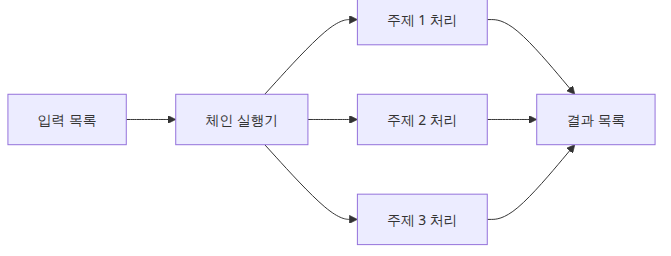
동일한 체인을 여러 입력에 반복 적용해야 할 때는 batch()를 씁니다. 체인을 새로 만들 필요는 없습니다. 같은 체인을 다른 실행 모드로 호출하는 것뿐입니다.
import os

from langchain_core.output_parsers import StrOutputParser
from langchain_core.prompts import ChatPromptTemplate
from langchain_groq import ChatGroq

prompt = ChatPromptTemplate.from_messages([
    ("human", "Explain {topic} in one sentence."),
])

llm = ChatGroq(
    model="llama-3.1-8b-instant",
    api_key=os.environ["GROQ_API_KEY"],
)

chain = prompt | llm | StrOutputParser()

topics = [
    {"topic": "embeddings"},
    {"topic": "FAISS"},
    {"topic": "RAG"},
]

results = chain.batch(topics)

for topic_dict, result in zip(topics, results):
    print(f"[{topic_dict['topic']}] {result}\n")
Output
[embeddings] In machine learning and natural language processing, embeddings are a way of representing words, phrases, or other data as numerical vectors in a high-dimensional space, allowing similar concepts to be clustered together and enabling models to capture nuanced relationships and patterns.

[FAISS] FAISS (Facebook AI Similarity Search) is an open-source library developed by Facebook and Carnegie Mellon University for efficient similarity search and clustering of dense vectors, typically used in large-scale machine learning and data analytics applications.

[RAG] RAG stands for Red, Amber, and Green, which is a traffic-light system used to categorize and track project progress, risks, and issues, with Red indicating critical problems, Amber signifying potential issues, and Green denoting successful completion or progress.
실무에서는 여기에 API 한도 문제가 곧바로 따라옵니다. batch()는 내부적으로 병렬 처리를 시도할 수 있으므로, 공급자 rate limit에 맞춰 동시성을 제한해야 할 때가 많습니다.
results = chain.batch(topics, config={"max_concurrency": 2})이 한 줄이 중요한 이유는, LLM 앱 성능 문제 상당수가 체인 구조보다 호출량 제어 부재에서 발생하기 때문입니다. 입문 때부터 batch()와 max_concurrency를 함께 떠올리면 운영 감각을 빨리 잡을 수 있습니다.
이 코드에서 주목할 점
prompt | llm | parser는 문자열 파이핑이 아니라, 호환되는 Runnable 입출력 타입을 잇는 합성입니다.ChatPromptTemplate는 메시지 객체를 만들고,ChatGroq는 그 객체를 별도 글루 코드 없이 바로 소비합니다.StrOutputParser가 있어야AIMessage가 아니라 애플리케이션 친화적인 문자열을 다음 단계에서 다루기 쉽습니다.batch()는 체인 설계를 바꾸지 않습니다. 같은 파이프라인을 여러 입력에 재사용하는 실행 모드입니다.
엔지니어가 자주 헷갈리는 지점
- 겉으로는 LCEL이 주인공처럼 보이지만, 실제 기반은 그 아래의 Runnable 계약입니다.
- 단계마다 출력 타입이 바뀝니다. 프롬프트 출력은 메시지, 모델 출력은
AIMessage, 파서 출력은 텍스트입니다. RunnableLambda는 편리하지만, 긴 비즈니스 로직을 체인 안에 넣으면 오히려 추론하기 어려워집니다.
체크리스트
-
ChatPromptTemplate,ChatGroq,StrOutputParser의 입력/출력 타입을 설명할 수 있다 - 같은 체인을
invoke()와batch()로 모두 실행해 볼 수 있다 - 일반 Python 함수를 언제
RunnableLambda로 감싸야 하는지 이해했다
정리
LCEL과 Runnable 인터페이스는 LLM 애플리케이션의 반복 배관 작업을 |로 연결 가능한 작은 부품들로 바꿔 줍니다. 각 컴포넌트가 invoke, batch, stream을 일관되게 제공하므로, 같은 입력 형식을 받는 다른 컴포넌트로도 쉽게 교체할 수 있습니다.
다음 글에서는 ChatPromptTemplate를 더 깊게 보고, system 메시지와 다중 변수 입력을 다루는 조금 더 현실적인 첫 체인을 만들어 보겠습니다.
시리즈 목차
- LangChain 소개 — LCEL과 Runnable 기본 (현재 글)
- Prompt와 LLM Chain — 체인 첫 번째 구성 (예정)
- Retriever — 문서 검색과 컨텍스트 주입 (예정)
- Tool Calling — 외부 도구 연결하기 (예정)
- Streaming — 실시간 출력 처리 (예정)
- 실전 체인 조립 — 컴포넌트를 하나로 연결하기 (예정)
참고 자료
'AI·LLM' 카테고리의 다른 글
| Retriever — 문서 검색과 컨텍스트 주입 (0) | 2026.05.11 |
|---|---|
| Prompt와 LLM Chain — 체인 첫 번째 구성 (0) | 2026.05.11 |
| 문서 수집 파이프라인 완성 (0) | 2026.05.05 |
| 다중 포맷 문서 파이프라인 (0) | 2026.05.05 |
| 증분 인덱싱 — 변경된 문서만 업데이트 (0) | 2026.05.05 |
- Total
- Today
- Yesterday
- frontend
- Cleancode
- APIDesign
- backend
- DevOps
- harness
- webdevelopment
- reliability
- AZURE
- Refactoring
- langchain
- rag
- Architecture
- ai safety
- ai agent
- AI Evaluation
- Azure Functions
- Production
- Agent
- DesignPatterns
- vector search
- openAI
- LLM
- Tool Use
- Cloud
- Computer Science
- embeddings
- softwaredesign
- http
- Python
| 일 | 월 | 화 | 수 | 목 | 금 | 토 |
|---|---|---|---|---|---|---|
| 1 | 2 | |||||
| 3 | 4 | 5 | 6 | 7 | 8 | 9 |
| 10 | 11 | 12 | 13 | 14 | 15 | 16 |
| 17 | 18 | 19 | 20 | 21 | 22 | 23 |
| 24 | 25 | 26 | 27 | 28 | 29 | 30 |
| 31 |